The Two Essential Frameworks to Eliminate Careless Errors and Decode Complex GCSE Word Problems
Owen
Pearson Edexcel Specialist · Former Assistant Principal · Former Advanced Skills Teacher · Former Mastery Lead
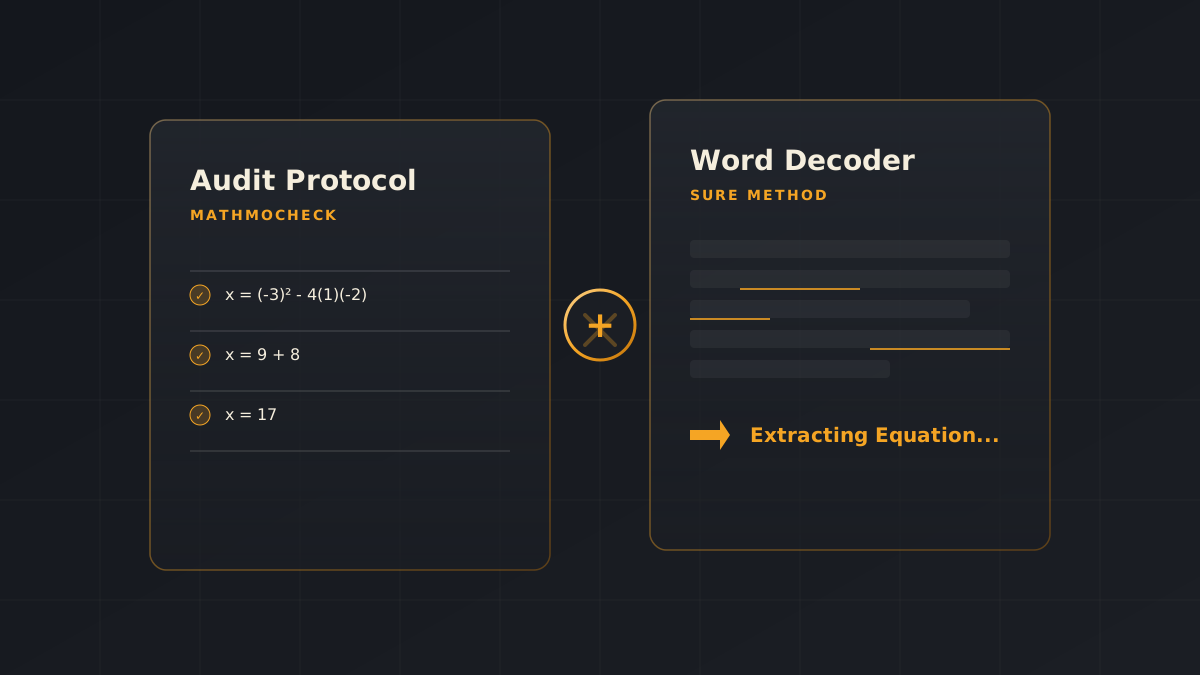
Every mathematics teacher knows the heartbreak of looking at a student's mock paper. The student clearly understood the underlying concepts, knew the theorem, and set up the problem correctly — yet lost three or four crucial marks simply because a negative sign vanished, a number was miscopied halfway down the page, or the final answer lacked units.
We have all heard advice like "check your work", but telling a teenager to "just check" a 90-minute exam paper is practically useless. Without a structured, step-by-step audit protocol, students tend to just stare blankly at their own handwriting, seeing what they meant to write rather than what is actually on the page.
Similarly, when confronted with a half-page narrative word problem, panic often sets in. Students read the block of text once, feel overwhelmed, and either guess an operation or freeze entirely.
That is why I use these two frameworks with my students. MathmoCheck is a targeted, memorable mental acronym designed specifically to catch those infuriating careless errors before the timer runs out. SURE is a four-step framework designed to deconstruct complex GCSE problem statements and extract a clear mathematical pathway.
Part 1: Stop Losing Easy Marks with MathmoCheck
A reliable check is not a vague re-read; it is a systematic audit of the most common failure points. MathmoCheck breaks the review process down into concrete physical checks (signs, copying, units), transforming "checking" from a vague wish into a concrete, repeatable skill. The graphic groups all six checks into four stages: signs and calculations, copying, reasonableness and method, then final-answer format.
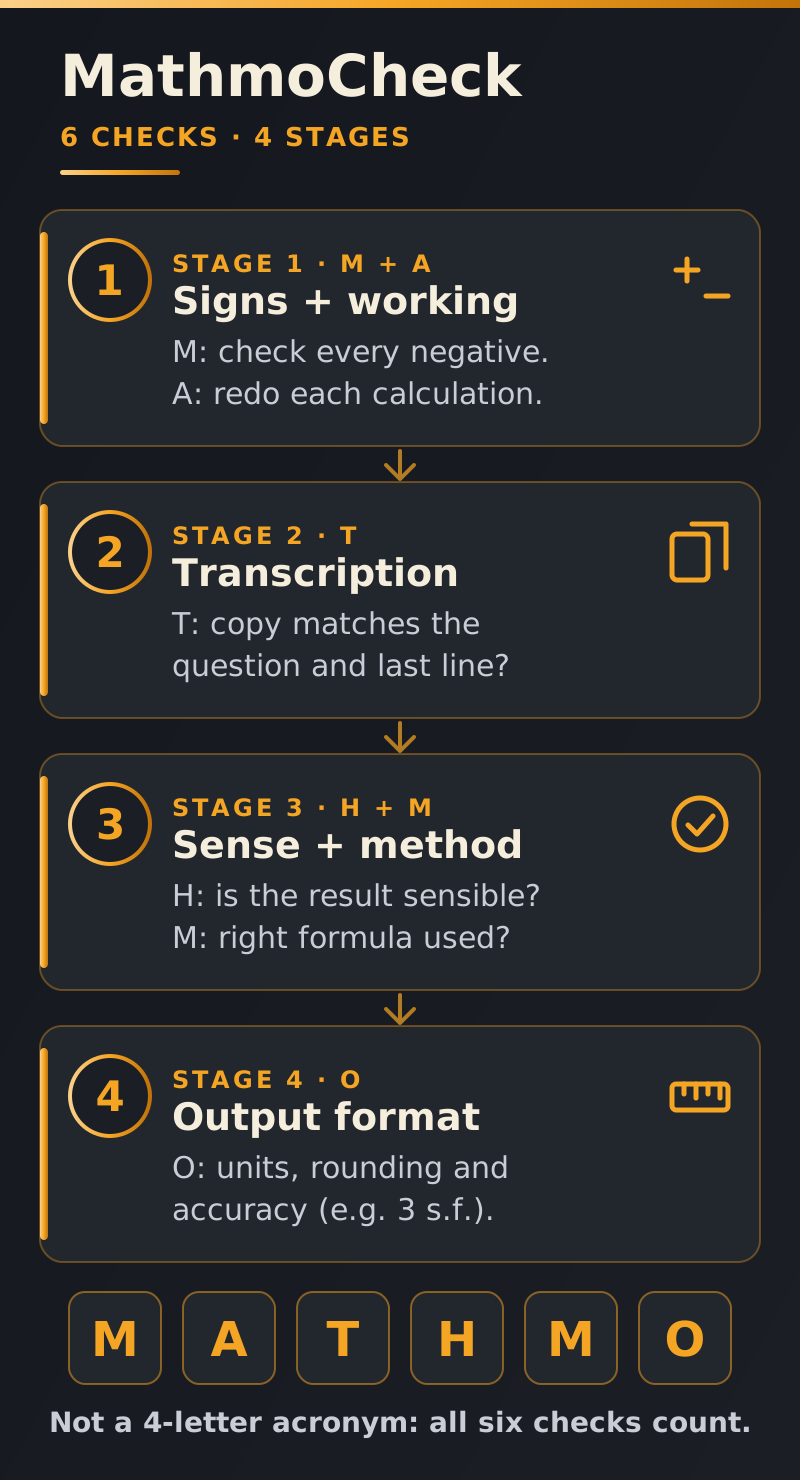
Let us look at a concrete GCSE example: evaluating a quadratic formula or expanding brackets. The "M" step (Minus and signs) forces you to specifically verify how you handled a negative. Did you evaluate -x² or (-x)²? When expanding -4(x - 2), did you carry the negative through to make it +8? Rather than checking the entire line of working at once, you scan strictly for negative signs.
The "T" step (Transcription) addresses the silent killer of top grades. You solved x = 4.5 on one line, but on the next line you wrote x = 4.2. By explicitly checking that numbers were copied accurately from the prompt and the previous line, you prevent cascading errors that ruin otherwise perfect working.
Part 2: Cracking Complex Word Problems with the SURE Method
For many GCSE students, the biggest barrier in a modern exam paper is not necessarily the complexity of the algebra or geometry — it is the prose. Examiners love wrapping standard mathematical principles inside dense, multi-sentence word problems involving currency exchanges, compound percentages, composite shapes, or ratio distributions.
To break through this cognitive gridlock, students need a reliable tactical entry point. The SURE method provides exactly that.
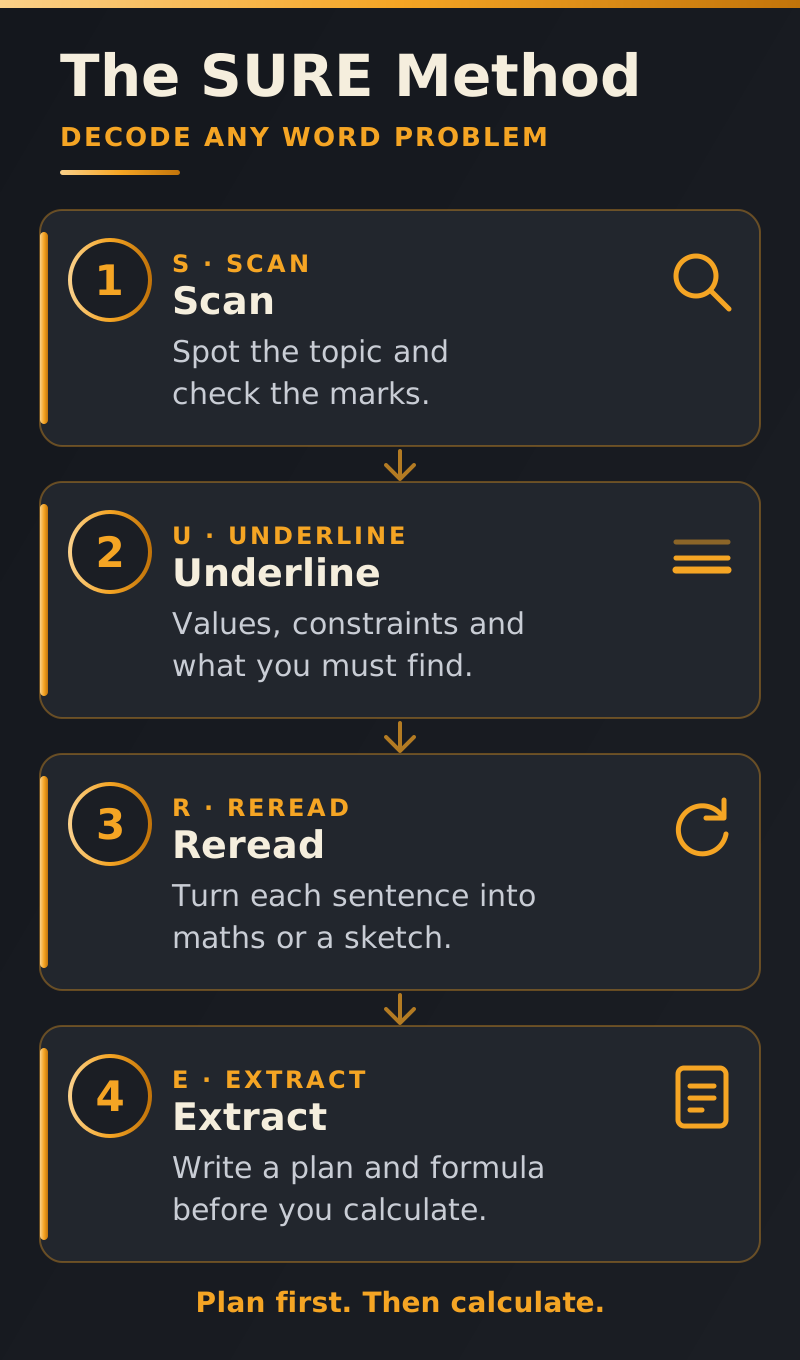
Imagine a typical Grade 7 or 8 question: a five-line paragraph detailing compound interest across two different banks, ending with a request to find the difference to the nearest penny.
Do not start calculating immediately. Scan (S) the text for 10 seconds to identify it as a compound interest problem. Underline (U) the initial values, the interest rates, the duration, and crucially, the final constraint ("to the nearest penny"). Reread (R) the text, writing down the compound interest formula for Bank A and Bank B. Finally, Extract (E) the plan: Calculate Bank A, calculate Bank B, subtract the two, and round to 2 decimal places. Now you can touch your calculator.
The Exam-Day Routine: When to Use These Methods
Having a framework is only half the battle; knowing when to deploy it is the other.
Do not wait until the very end of the exam to run through MathmoCheck. By the 85-minute mark, cognitive fatigue has set in. Instead, use MathmoCheck as a micro-routine after completing every 2 or 3 high-tariff questions, or as a final 5-minute sweep across structured multi-part problems.
Deploy the SURE method the moment you see a multi-sentence narrative block (typically 3 or more lines of text). Mathematics is not a spectator sport, nor is it a reading comprehension test where you guess the meaning of a paragraph. By systematically scanning and extracting, you strip away the intimidation factor.
When students realise they have a repeatable system to untangle any word problem and audit their working, anxiety drops and mathematical reasoning takes over.
Ready to build bulletproof exam technique?
Top grades require more than just subject knowledge; they require unshakeable exam technique. If you are aiming for a Grade 9 and want to master these high-performance routines, get in touch to secure a 1-to-1 coaching slot.
Ready to target a Grade 9?
Availability is strictly limited. Work directly with Owen on the questions that matter most.
Apply for Tutoring