Stop Repeating Your Mistakes: How Video Clips Can Transform Your Exam Prep
Owen
Pearson Edexcel Specialist · Former Assistant Principal · Former Advanced Skills Teacher · Former Mastery Lead
You sit down to revise, work through a set of past-paper questions and check your answers against the mark scheme. It feels productive. Yet, when a similar question appears in your next test, you make the same mistake again.
The problem is not necessarily a lack of effort. It may be what happens after you discover that an answer is wrong. Checking an answer tells you whether you got it right; it does not automatically teach you how to put the mistake right.
That is the purpose of the question clips on MyGrade9MathsTutor: to help you move from spotting a mistake to understanding the method and practising it. Used actively, alongside the worksheets, they can make your GCSE and IGCSE Maths revision much more purposeful.
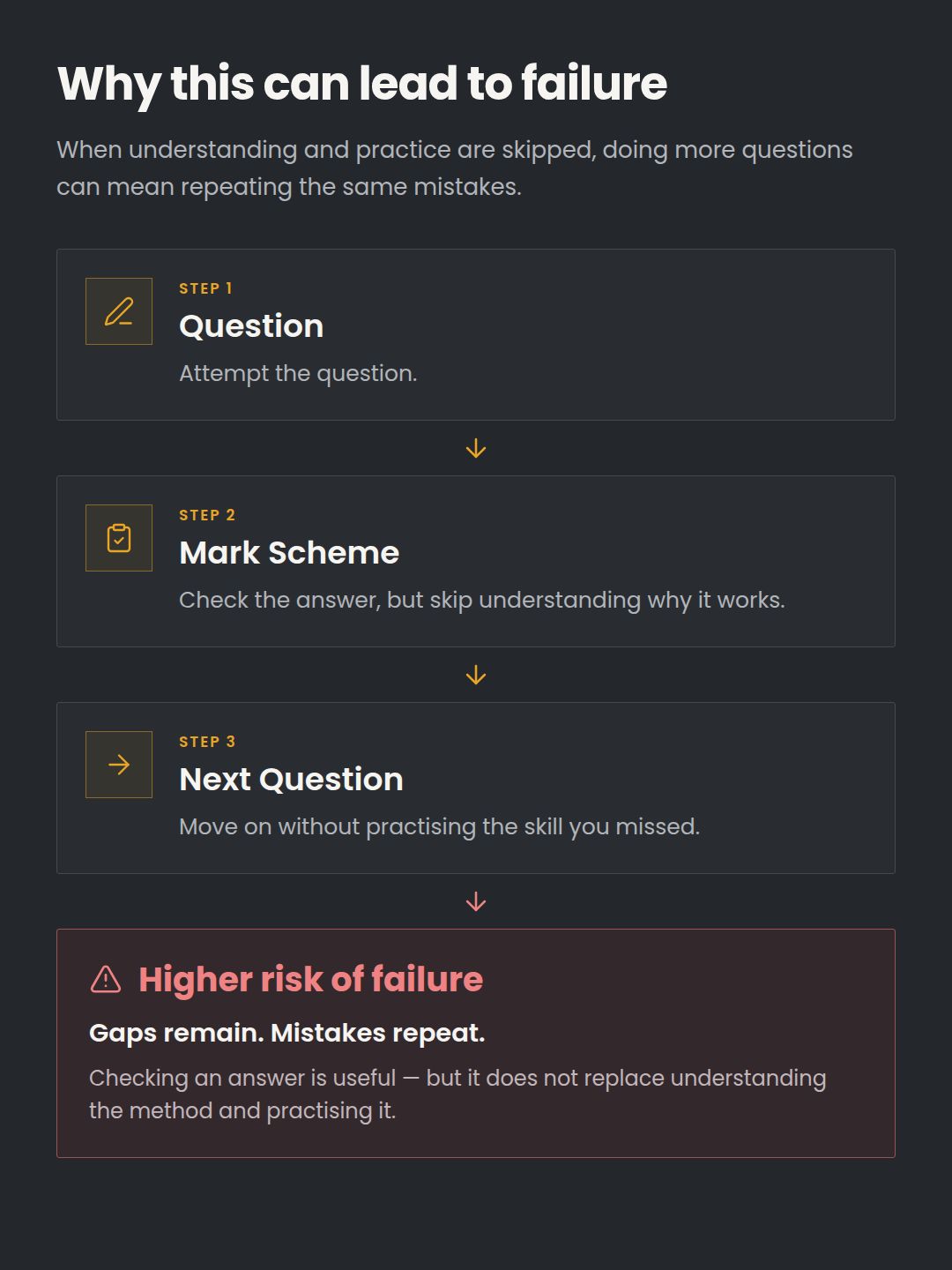
The trap: Question → Mark Scheme → Next Question
A mark scheme is a useful resource. It shows how marks are awarded and helps you identify missing working, an incorrect method or an inaccurate answer. The difficulty comes when you check it, recognise the correct answer and immediately move on.
If you have not understood why the method works or tried the skill again, the gap may still be there. Completing more questions can then mean repeating the same error rather than fixing it.
The graphic below is not saying that using a mark scheme causes failure. It highlights the risk of skipping understanding and practice. You need to do something with the mistake you have just found.
The other trap: watching without attempting
Video walkthroughs can become another form of passive revision if you press play before making an attempt, watch the tutor complete the question and then move straight to the next video. The explanation may make sense while it is in front of you, but that does not show whether you could choose the method or carry out the steps on your own.
The danger is false confidence: “I understood that” can feel like “I can do that”. In an exam, there is no narrator choosing the first step, reminding you of a rule or revealing the next line of working. Recognising a solution and producing one independently are different tasks.
Copying every line of a walkthrough without thinking can hide the same problem. You may finish with a neat, correct solution in your book, but still be unable to explain why a step was needed or adapt the method when the numbers change.
Attempt the question before watching, pause the clip to predict or complete the next step, and then close the video and try a fresh question. Only check the practice solution after making your own attempt. If you cannot start the original question, write down what you know and where you are stuck, then use the walkthrough to address that specific difficulty rather than watching aimlessly.
The clips are support for your thinking, not a replacement for it. Watching is part of the routine; attempting, explaining and practising are what let you check whether the learning has actually happened.
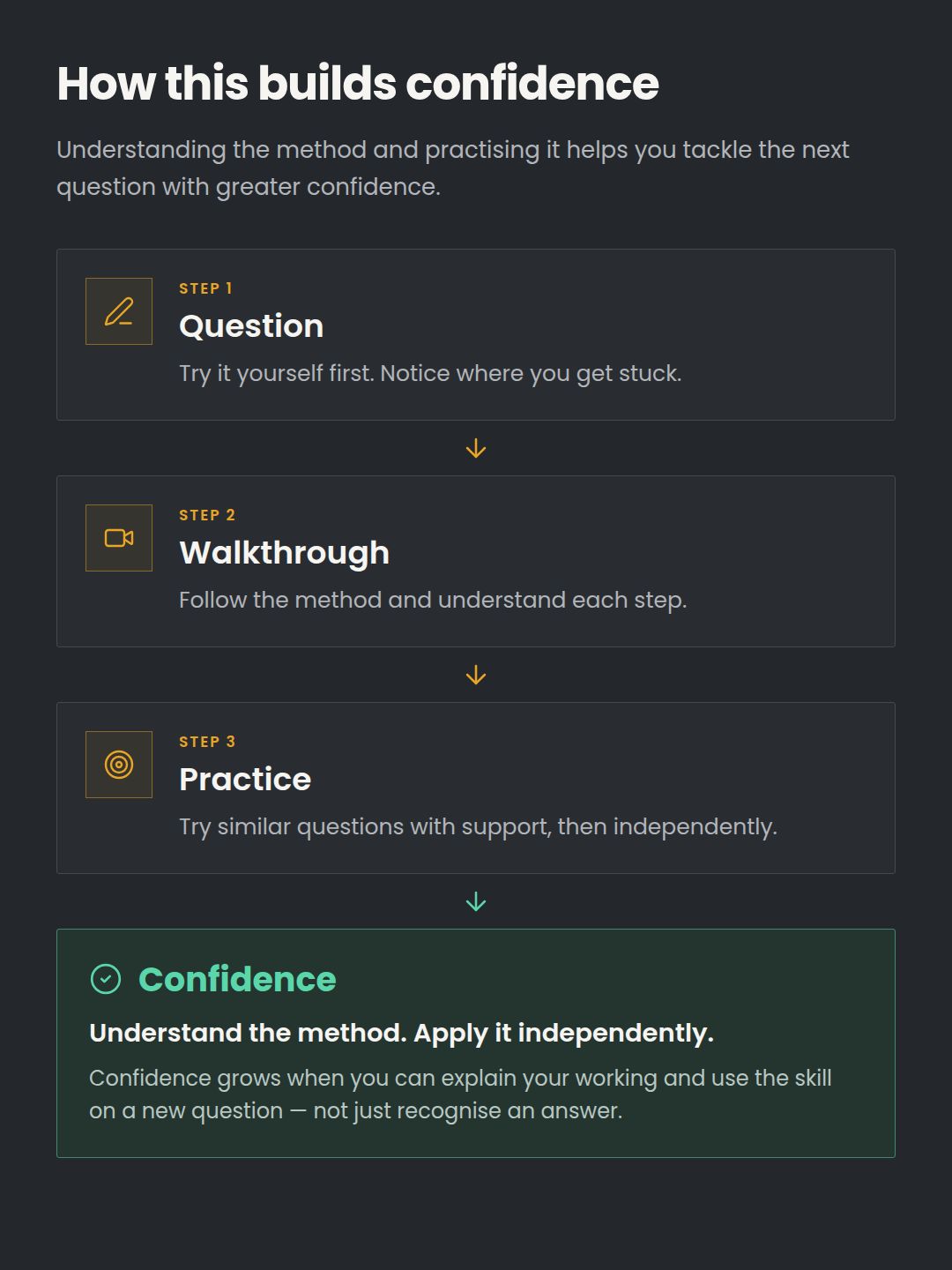
A better route: Question → Walkthrough → Practice → Confidence
Instead of moving straight to another question, use the mistake as a starting point. Watch the relevant walkthrough, pause at the step that caused difficulty and work out what you need to change. Then put that understanding to the test on a similar question.
This is where the site offers more than a collection of answers. The worksheets and clips give you a way to connect an exam question with a worked method and opportunities to practise. You can return to the explanation, pause it and revisit the part you need.
Confidence should come from being able to apply a method independently, not just from recognising it while someone else explains it. The practice stage is what helps you check the difference.
How to use the clips: the five-step routine
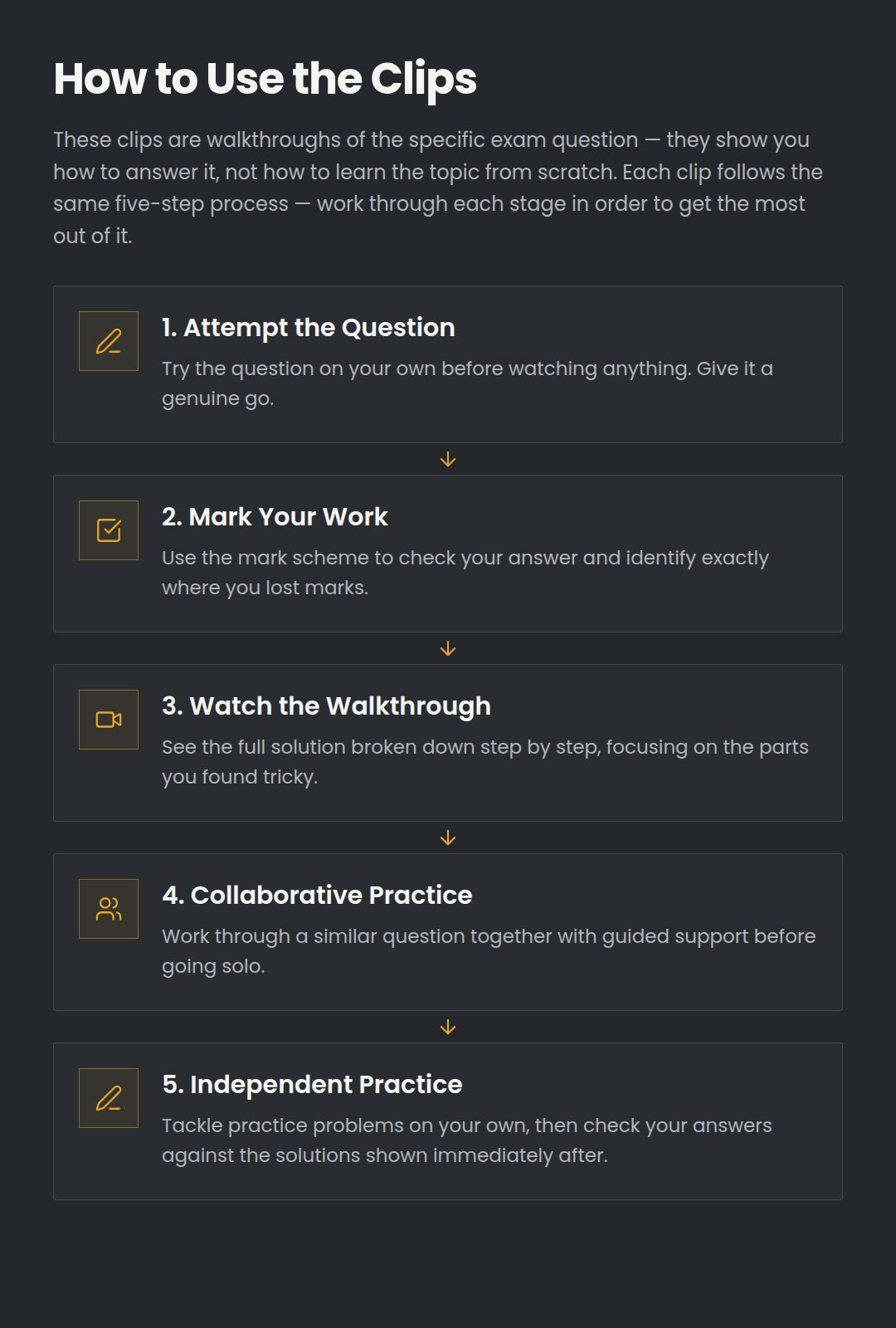
These clips are walkthroughs of specific exam questions. They show you how to answer the question; they are not a substitute for learning an unfamiliar topic from scratch. If the underlying topic is new to you, revisit the foundations or ask for help before expecting an exam walkthrough to fill every gap.
For a question you are ready to tackle, use the full routine below. Do not stop at watching the solution: the guided and independent practice are important parts of the process.
1. Attempt the question
Give the question a genuine go before watching the clip. Write down your working, even if you cannot finish. Your attempt helps you identify whether the difficulty is choosing a method, carrying it out or interpreting what the question is asking.
2. Mark your work
Use the mark scheme to check your answer and identify where you lost marks. Be specific: “I mishandled the negative sign when expanding the bracket” is more useful than “I got the algebra wrong”. Keep your original working so you can compare it with the explanation.
3. Watch the walkthrough
Watch the solution step by step, focusing on the point where your working went off track. Pause before the next step and try it yourself. Ask why that step is needed and how it connects to the question. Simply copying the finished solution is not the same as understanding it.
If you skipped your initial attempt, stop and make one now. Do not use the ease of following the tutor as your measure of progress: check whether you can explain the method and complete a similar question without the clip.
4. Complete collaborative practice
Work through a similar question with the guided support in the clip. Try to do the next step before the explanation reveals it. This gives you an opportunity to apply the method while support is still available, before you work entirely on your own.
5. Complete independent practice
Attempt the practice problems yourself before checking the solutions shown afterwards. If you still make the same mistake, return to the relevant part of the walkthrough and try again. Revisit the skill in a later revision session too: getting it right immediately after a demonstration is not the only check that matters.
What fixing a mistake actually looks like
Suppose you expand −4(x − 2) and write −4x − 8. The correct expression is −4x + 8. Reading that answer in a mark scheme may help you spot the error, but you still need to understand why multiplying two negative numbers gives a positive result.
After reviewing the explanation, try a different expression, such as −3(2x − 5). Can you obtain −6x + 15 without looking at the solution, and explain the sign of each term? A changed question helps you check whether you have understood the method rather than remembered an answer.
That small sequence — identify the error, understand it, practise and check independently — is more useful than rushing through another page of questions without addressing the gap.
Make your next revision session count
Choose a worksheet from the MyGrade9MathsTutor resource library and, where a clip is available, follow the five-step routine. Keep a brief note of the mistake you corrected and the skill you want to revisit. The aim is not simply to complete more questions; it is to leave the session able to do something you could not do confidently before.
Watching a clip cannot guarantee a particular grade. But using the explanation alongside genuine attempts and independent practice gives you a practical way to make your revision more active and focused.
If you need help identifying the gaps, choosing suitable questions or applying methods consistently, 1-to-1 tutoring can provide more personalised support. Start with the resources, or check tuition availability if you would like guidance.
Ready to target a Grade 9?
Availability is strictly limited. Work directly with Owen on the questions that matter most.
Apply for Tutoring